In Dante’s Inferno, the poet is guided by Virgil on a journey through the nine circles of Hell, witnessing the punishment of souls in ways that are appropriate to the sins they committed in life – a process described as contrapasso,’to suffer the opposite’. Souls are trapped for eternity in a state of retribution specific to their own wrongdoing.
Continue readingTag Archives: Poetry
MACHINATIONS – an interview with Kinneson Lalor and JP Seabright
‘Can machines think?’
Alan Turing posed this question in his seminal 1950 paper ‘Computing Machinery and Intelligence’ that laid the foundations for research into artificial intelligence. Turing’s life and work provide the inspiration for Machinations, a poetic collaboration between Kinneson Lalor and JP Seabright published by Trickhouse Press. Fiercely intelligent, dazzlingly inventive and profoundly insightful, Machinations does justice not only to the depth, breadth and creative genius of Turing’s intellectual achievements but also to the complex layers of his personality.
I asked Kinneson and JP how the book came into being, their experience of working together and what informed their creative choices.
Continue readingGhost Mill, revisited
            Again
grooved granite mill-stones grind
formless flour from coarse grain.
The brake wheel clanks; the wind
thrums an untuned refrain.
This poem first appeared on The Wombwell Rainbow in October 2022. The form is known as a Bob and Wheel and dates back to mediaeval times.
The melodic and the logical – an interview with Anthony Etherin
The Golden Ratio, denoted by the Greek letter phi, is an irrational number that has intrigued mathematicians and artists through the centuries, featuring in geometry, number theory, physics, biology, painting, architecture, music and other disciplines. Its value to 20 digits is
Continue readingElevenses
Squeezed awkwardly between the round completeness
of 10 and factored convenience of 12,
11 is the odd one out. We don’t have
11 fingers or toes; we never buy
11 rolls, or eggs, or long-stemmed roses
for our lover. In binary notation
its digits become the three of us, on our
terrace with coffee and scones in the sunlight
and birdsong of June, while the radio plays
Test Match Special and 11 extends its
parallel arms towards the unbounded sky.
This is a square poem: there are 11 syllables per line and 11 lines.
It was first published in The Book of Penteract.
Snails
A

thin

slime trail

meanders

over the gravel

to my flowerbeds, where hostas

that I had tended so carefully have been reduced

to tattered shreds. A robin perches among panicles of lilac as you approach

with buttered scones and coffee. Light slants through leaves, glistens the slime trail silver. Everything contributes to the dazzle of this day – even snails.


This Fibonacci poem was first published in The Fib Review Issue #41
Playing to our own rules: Poetic constraint
1
Arma virumque cano – ‘I sing of arms and the man’. With these resonant words Virgil opens his great epic the Aeneid, composed over two thousand years ago. The poem, which is nearly ten thousand lines long, is written almost entirely in dactylic hexameter – an astonishing feat of constrained writing, especially when we consider that Virgil lacked the convenience of our modern-day word processing and editing tools.
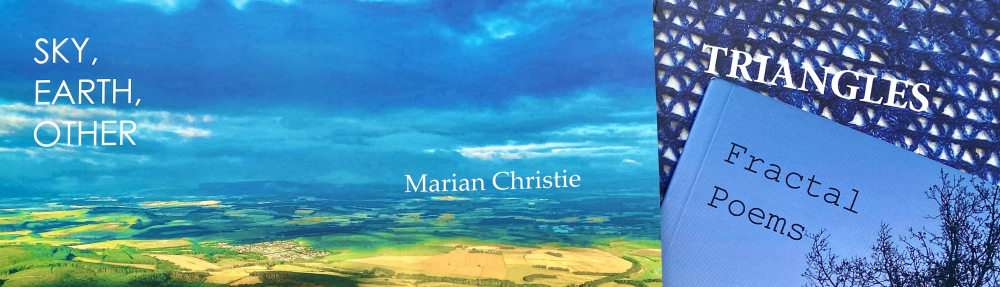
Continue readingPoetry and Fractals
In his 1982 book ‘The Fractal Geometry of Nature’ the mathematician Benoit Mandelbrot explored ‘irregular and fragmented patterns around us’ that ‘tend to be scaling, implying that the degree of their irregularity and/or fragmentation is identical at all scales.’
He called this family of shapes fractals, from the Latin adjective fractus, meaning fragmented or irregular. Such objects, Mandelbrot noted, are present in nature as well as in a wide range of fields.
Continue readingMathematical forms in poetry 4 – Permutations
Permutations are a feature of many poetic forms: rhyme and metrical patterns, the arrangement of lines in a villanelle or pantoum, the rotation of end-words through the stanzas of a sestina. Ruth Holzer’s ‘For Dylan Thomas on His Hundredth Birthday’ is an example of a sestina by a contemporary poet, with end-words wild, sky, end, hills, wave, love.
Continue reading