Last month Tesserae: A mosaic of poems by Zimbabwean women, was released into the world. Working on this book with Samantha Vazhure, founder and editor of Carnelian Heart Publishing, and the wonderful poets whose voices are featured within its pages, has been an immensely rewarding experience.
Continue readingTag Archives: mathematical poetry
Rock, Paper, Scissors: Shape and Surface as Constraint
Messages from the past take many forms: ancient structures, buildings, and artefacts; burial sites; rituals and symbolism; stories, poems and songs shared through generations; sculptures, paintings, works of art.
Continue readingSeasons and Landscapes: A fortune teller origami poem
When I was a child, my friends and I enjoyed crafting and playing with paper fortune-tellers, a form of origami made with square paper folded in a sequence of triangles.
The illustration below is of my fortune teller poem Seasons and Landscapes in two dimensions. You can download a PDF version to print out and fold into shape here. Folding instructions are given here (or here if you prefer a video version).

A Penrose Stairs Poem
This poem was inspired by M. C. Escher’s lithograph Ascending and Descending (1960), which depicts figures on a staircase that appears to rise – or descend – in a continuous loop. This impossible construction is named the Penrose stairs, after Lionel and Roger Penrose.
The poem can in principle be read from almost any starting point, and in any direction.
The Gym

‘We imagine we are climbing: every step is about 20 cm high, terribly exhausting and where does it get us? Nowhere; we don’t get one step further or higher.’
M. C. Escher, On Ascending and Descending, 1960.
Triangles
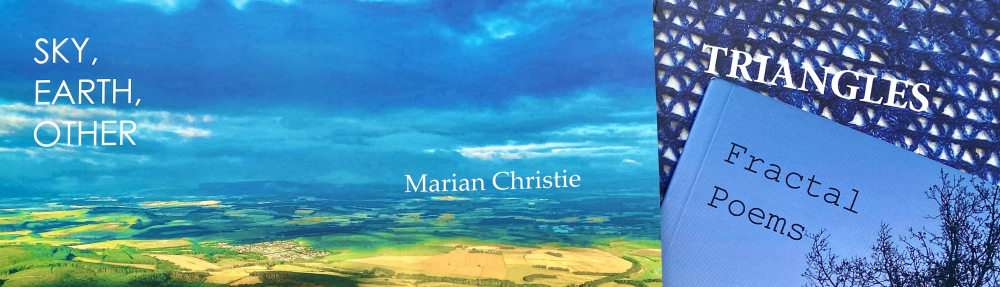
Triangles, my new poetry collection, is now available to purchase directly from Penteract Press, who ship all over the world.
Billy Mills has generously written a review, which you can read here: https://ellipticalmovements.wordpress.com/2023/10/26/recent-reading-october-2023/
You can order a copy at this link: https://penteractpress.com/store/triangles
The Poetry and Mathematics of Crochet
There may be poets who can sit in front of their computer or notebook and spontaneously compose a poem, but I am not one of them. Generally, my poems have a long gestation. I tend to mull them over while doing other things: gardening, walking, cleaning the bathrooms. Crocheting.
Continue readingMACHINATIONS – an interview with Kinneson Lalor and JP Seabright
‘Can machines think?’
Alan Turing posed this question in his seminal 1950 paper ‘Computing Machinery and Intelligence’ that laid the foundations for research into artificial intelligence. Turing’s life and work provide the inspiration for Machinations, a poetic collaboration between Kinneson Lalor and JP Seabright published by Trickhouse Press. Fiercely intelligent, dazzlingly inventive and profoundly insightful, Machinations does justice not only to the depth, breadth and creative genius of Turing’s intellectual achievements but also to the complex layers of his personality.
I asked Kinneson and JP how the book came into being, their experience of working together and what informed their creative choices.
Continue readingThe melodic and the logical – an interview with Anthony Etherin
The Golden Ratio, denoted by the Greek letter phi, is an irrational number that has intrigued mathematicians and artists through the centuries, featuring in geometry, number theory, physics, biology, painting, architecture, music and other disciplines. Its value to 20 digits is
Continue readingElevenses
Squeezed awkwardly between the round completeness
of 10 and factored convenience of 12,
11 is the odd one out. We don’t have
11 fingers or toes; we never buy
11 rolls, or eggs, or long-stemmed roses
for our lover. In binary notation
its digits become the three of us, on our
terrace with coffee and scones in the sunlight
and birdsong of June, while the radio plays
Test Match Special and 11 extends its
parallel arms towards the unbounded sky.
This is a square poem: there are 11 syllables per line and 11 lines.
It was first published in The Book of Penteract.
Snails
A

thin

slime trail

meanders

over the gravel

to my flowerbeds, where hostas

that I had tended so carefully have been reduced

to tattered shreds. A robin perches among panicles of lilac as you approach

with buttered scones and coffee. Light slants through leaves, glistens the slime trail silver. Everything contributes to the dazzle of this day – even snails.


This Fibonacci poem was first published in The Fib Review Issue #41