The Golden Ratio, denoted by the Greek letter phi, is an irrational number that has intrigued mathematicians and artists through the centuries, featuring in geometry, number theory, physics, biology, painting, architecture, music and other disciplines. Its value to 20 digits is
Continue readingAuthor Archives: Marian Christie
Turning in circles – the Tritina
Repetitions are a feature of many established poetic forms – the triolet, pantoum, and villanelle all contain patterns of repeated lines, while the ghazal consists of couplets with a repeated refrain. The sestina is determined by six end-words, following a fixed rotational pattern through six six-line stanzas, with a three-line envoi that includes all the end-words.
Continue readingElevenses
Squeezed awkwardly between the round completeness of 10 and factored convenience of 12, 11 is the odd one out. We don’t have 11 fingers or toes; we never buy 11 rolls, or eggs, or long-stemmed roses for our lover. In binary notation its digits become the three of us, on our terrace with coffee and scones in the sunlight and birdsong of June, while the radio plays Test Match Special and 11 extends its parallel arms towards the unbounded sky.
This is a square poem: there are 11 syllables per line and 11 lines.
It was first published in The Book of Penteract.
Snails
A thin slime trail meanders over the gravel to my flowerbeds, where hostas that I had tended so carefully have been reduced to tattered shreds. A robin perches among panicles of lilac as you approach with buttered scones and coffee. Light slants through leaves, glistens the slime trail silver. Everything contributes to the dazzle of this day – even snails. This Fibonacci poem was first published in The Fib Review Issue #41
Playing to our own rules: Poetic constraint
Arma virumque cano – ‘I sing of arms and the man’. With these resonant words Virgil opens his great epic the Aeneid, composed over two thousand years ago. The poem, which is nearly ten thousand lines long, is written almost entirely in dactylic hexameter – an astonishing feat of constrained writing, especially when we consider that Virgil lacked the convenience of our modern-day word processing and editing tools.
Continue readingRoutes through a poem
Sometime during the fourth century, in northwest China, a woman named Su Hui picked up her silk thread and embarked on an embroidery project. The result was an extraordinary work of visual poetry – a grid of 29 x 29 characters, shuttle-woven on brocade to form a palindrome poem that would become known as Xuanji Tu, or the ‘Star Gauge’.
Continue readingIterations of Emptying


‘Iterations of Emptying’ is shaped by the Sierpinski carpet fractal. It was first published in the Journal of Humanistic Mathematics, Volume 11 Issue 1 (2021) and has also appeared in Poetrishy #1.
Farewell to 2021
As we approach the end of a year dominated by chaos, bleakness, and the ravages of the pandemic, it is difficult not to succumb to despair. We seem to be caught up in the ‘widening gyre’ of Yeats:
Things fall apart; the centre cannot hold; Mere anarchy is loosed upon the world
Yeats wrote ‘The Second Coming’ in January 1919, at a time when the First World War had only recently ended, the political situation in his native Ireland was dangerously unstable and the Spanish ‘flu pandemic was raging (his pregnant wife Georgie Hyde-Lees became very ill and almost died from the ‘flu). It’s hardly surprising that a sense of impending doom reverberates through the poem.
Continue readingCircles within Circles

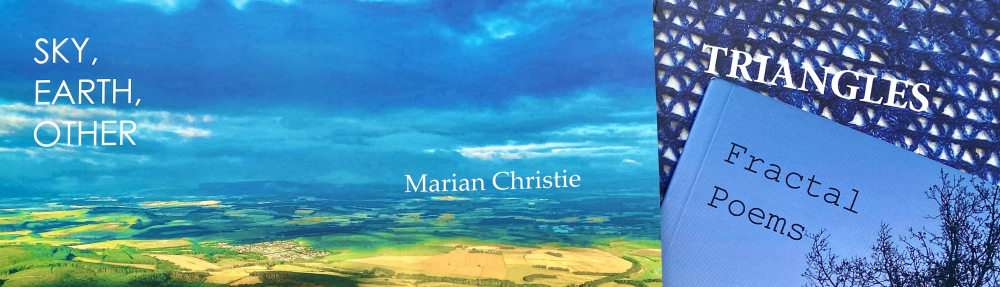
This poem first appeared in my pamphlet Fractal Poems (Penteract Press, 2021)
Conics and Kisses: Poetry shaped by Apollonius of Perga
I used to loathe coordinate geometry at school, mainly because we had to calculate, plot and draw the graphs by hand. My geometry notebooks were full of wobbly parabolas and ellipses that staggered uncertainly from point to point rather than flowing in one smooth, continuous curve.
Continue reading